Neural coupling refers to the statistical dependence between features of neural oscillations, such as phase and amplitude, across different signals or frequency bands. These interactions can be investigated at two main levels: synchronization between oscillations recorded from different brain regions and interactions between neural rhythms operating at different frequencies.
Major Types of Coupling in EEG
1. Phase Synchronization
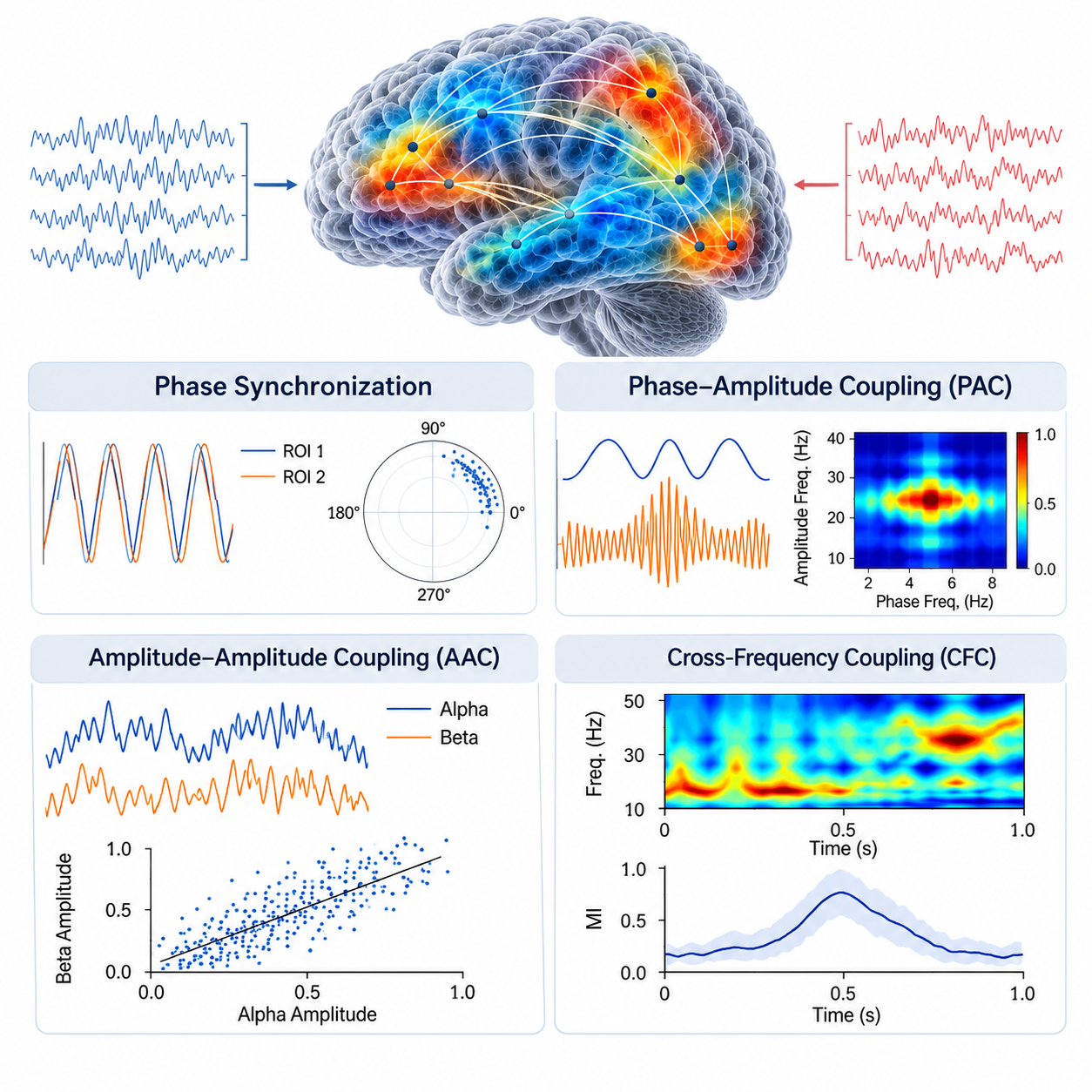
Phase synchronization examines the consistency of the phase difference between two neural signals, typically within a specific frequency band. This measure can provide information about the coordination of neural activity across different brain regions. Common metrics include the Phase Locking Value (PLV), Phase Lag Index (PLI), and weighted Phase Lag Index (wPLI).
2. Phase–Amplitude Coupling (PAC)
PAC examines the relationship between the phase of a slower oscillation and the amplitude of a faster oscillation. For example, the amplitude of gamma activity may vary as a function of the phase of theta oscillations, meaning that faster neural activity becomes stronger at specific phases of the theta cycle.
3. Amplitude–Amplitude Coupling (AAC)
AAC measures the co-variation between the amplitudes or amplitude envelopes of two oscillations occurring at different frequencies. For example, it can be used to investigate whether fluctuations in alpha and beta amplitude are statistically related over time.
4. Cross-Frequency Coupling (CFC)
CFC is a general term describing interactions between features of neural oscillations occurring at different frequency bands. PAC and AAC are two important forms of cross-frequency interaction. Phase–phase interactions between oscillations at different frequencies can also be investigated within this framework.
Why Is Neural Coupling Important?
A major hypothesis in neuroscience is that interactions between slow and fast neural oscillations may contribute to the coordination of neural processing across different temporal scales.
For example, in proposed models of neural communication, the phase of theta oscillations may organize the timing of fluctuations in gamma amplitude. This pattern has been discussed as a potential mechanism for organizing neural activity during cognitive processes such as memory, attention, and information processing (Canolty & Knight, 2010).
An Important Consideration in Interpreting Results
The observation of neural coupling does not necessarily indicate a direct connection between two brain regions or demonstrate the transfer of information from one region to another. Factors such as volume conduction, common neural input, and waveform properties can influence coupling estimates or generate apparently significant coupling patterns.
Therefore, selecting appropriate coupling metrics, controlling for artifacts, and applying robust statistical approaches—particularly surrogate-data testing—are essential for the reliable interpretation of coupling results.
Selected References
Canolty, R. T., & Knight, R. T. (2010). The functional role of cross-frequency coupling. Trends in Cognitive Sciences, 14(11), 506–515. https://doi.org/10.1016/j.tics.2010.09.001
Aru, J., et al. (2015). Untangling cross-frequency coupling in neuroscience. Current Opinion in Neurobiology, 31, 51–61. https://doi.org/10.1016/j.conb.2014.08.002
Bastos, A. M., & Schoffelen, J.-M. (2016). A tutorial review of functional connectivity analysis methods and their interpretational pitfalls. Frontiers in Systems Neuroscience, 9, 175. https://doi.org/10.3389/fnsys.2015.00175
Donoghue, T., Schaworonkow, N., & Voytek, B. (2022). Methodological considerations for studying neural oscillations. European Journal of Neuroscience, 55(11–12), 3502–3527. https://doi.org/10.1111/ejn.15361