Microstates are relatively stable periods in the spatial distribution of electrical potential across the scalp. They typically last tens to hundreds of milliseconds before transitioning to another pattern. Classical studies have shown that a substantial proportion of the spatial patterns of resting-state EEG activity can be described by a limited number of recurring configurations. This finding raises a fundamental question:
Do microstates reflect dynamic changes in neural networks involved in processes such as attention, perception, and consciousness?
Four Classical Patterns and Their Associations with Brain Networks
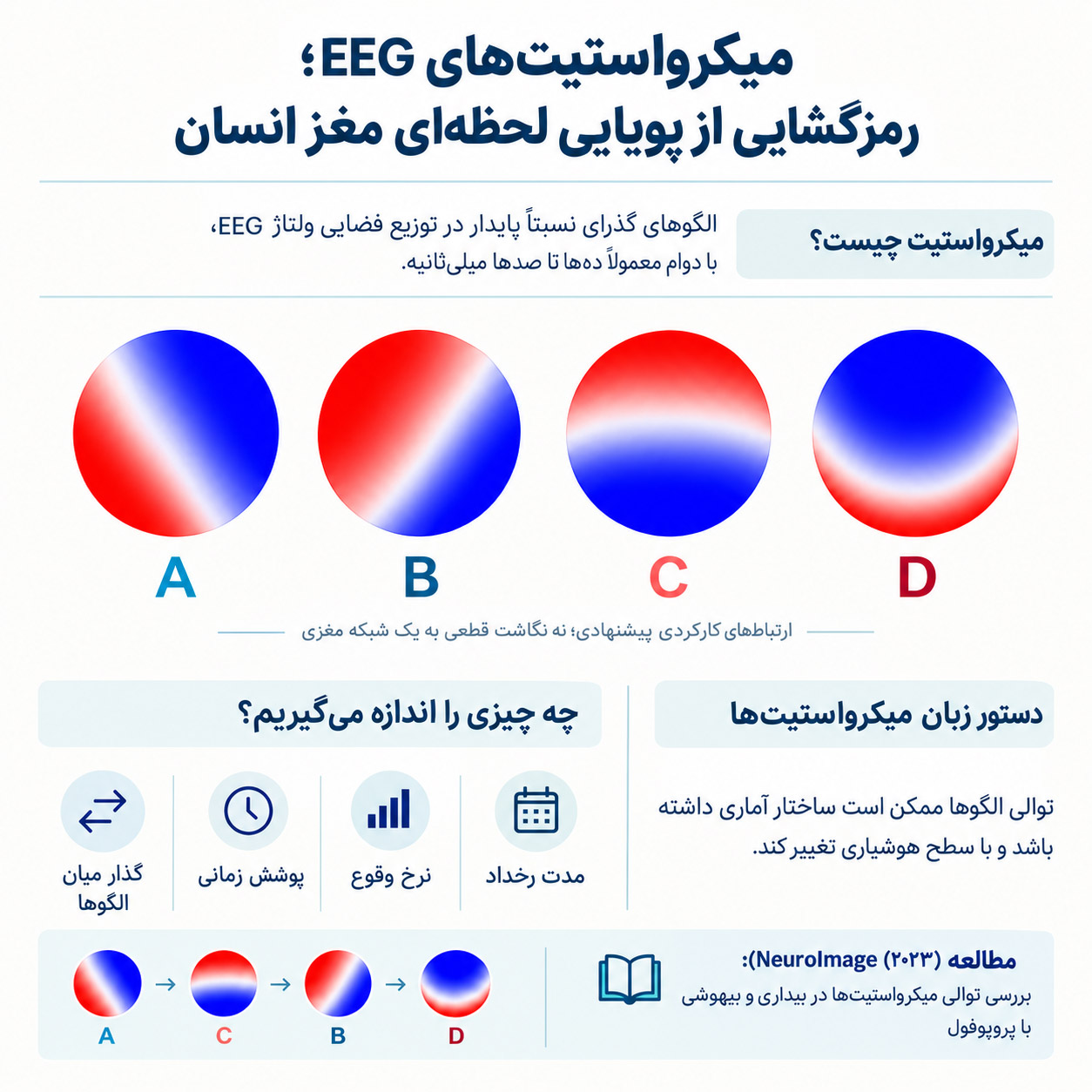
In many resting-state EEG studies, four common classes, designated A, B, C, and D, have been identified. Researchers have investigated the potential associations of these patterns with auditory, visual, salience, and attention networks. However, no microstate class can yet be definitively equated with a specific network or cognitive function.
The significance of these patterns extends beyond their spatial configurations. The mean duration of each occurrence, occurrence rate, percentage of temporal coverage, and transitions between classes can provide different types of information about the dynamics of brain activity. Thus, two individuals may exhibit similar spatial patterns while differing in the temporal organization of their brain activity.
Does the Brain Have Its Own Grammar?
In recent years, researchers have moved beyond examining individual microstate characteristics to investigate the sequence in which these states emerge. This approach, known as microstate syntax, examines whether the sequences of these states follow specific statistical rules and temporal structures.
In a study published in NeuroImage in 2023, researchers used the Microsynt method to investigate microstate sequences during wakefulness and deep propofol-induced anesthesia. The results showed that these sequences were not entirely random and that the distribution of certain sequential patterns changed with alterations in the state of consciousness.
These findings suggest that the sequential organization of brain states may provide information beyond that captured by the duration and frequency of individual microstate classes.