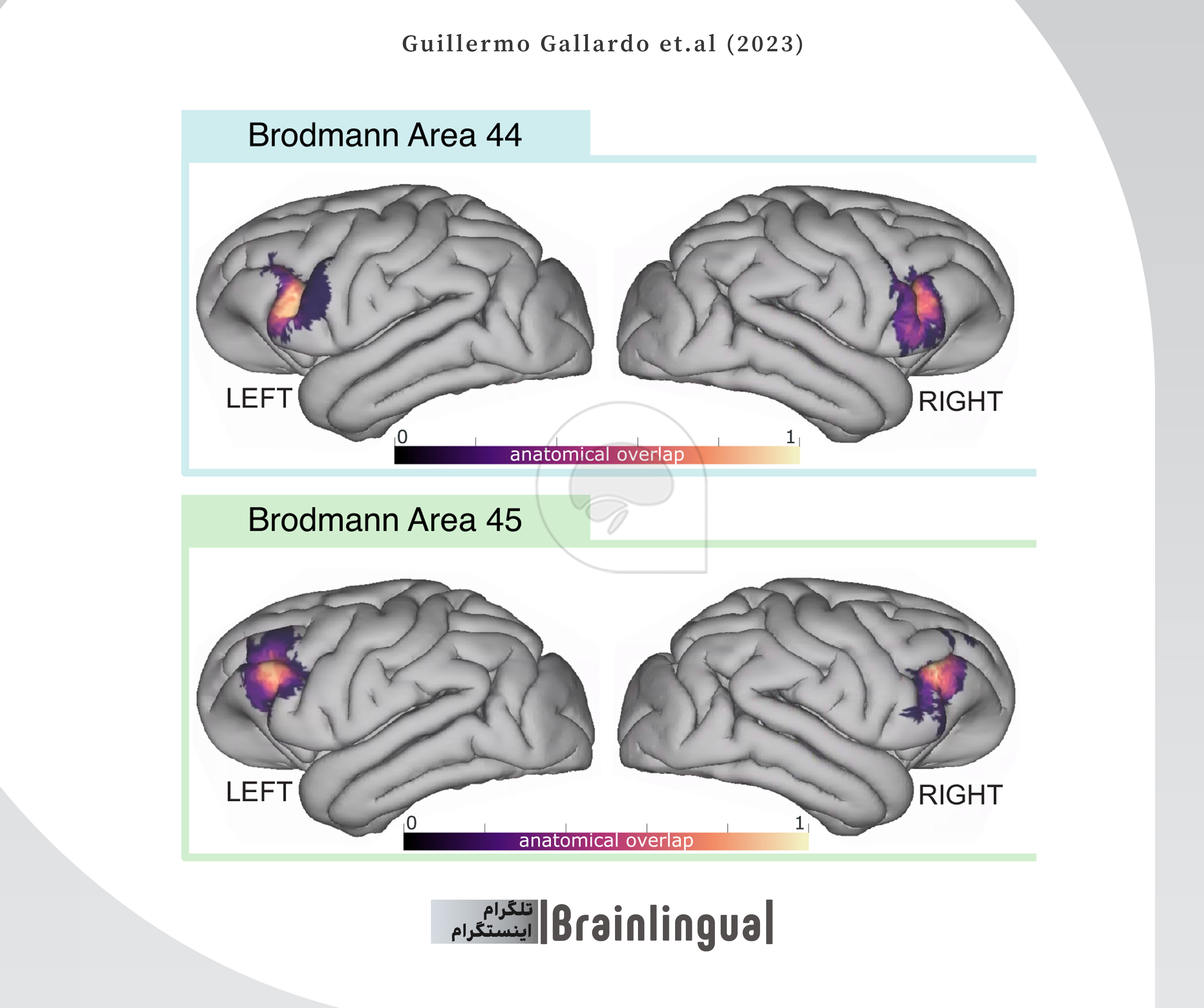
The research team used advanced cortical surface reconstruction and histological data to accurately reconstruct the brains of nine chimpanzees. They then performed interspecies registration, aligning chimpanzee and human brains using advanced algorithms to enable direct comparison of corresponding histological regions. The findings show that while BA44 is strongly lateralized to the left hemisphere and is larger in humans, chimpanzees show no statistically significant difference in the size of this region between the two hemispheres, indicating a largely symmetrical organization. This suggests that the lateralization of Broca’s area emerged after the evolutionary lineage leading to humans diverged from that of chimpanzees. Overall, BA44 is larger in humans than in chimpanzees. Interestingly, this volumetric expansion is substantially greater in the human left hemisphere, which is 1.64 times larger than the corresponding chimpanzee region, compared with a considerably smaller increase in the right hemisphere. This expansion occurs predominantly in the anterior portion of the region—the part that, in humans, is associated with the processing of syntax and complex linguistic rules.
Comparison of the resulting functional maps shows that chimpanzee BA44 corresponds almost precisely to the posterior portion of human BA44. In the human brain, this posterior region is involved in action representation and the execution of motor actions. Remarkably, the chimpanzee Broca’s area shows almost no overlap with the anterior portion of human BA44, which is associated with syntactic processing.
Taken together, the results support the view that BA44 underwent a major transformation during evolution—from a region primarily associated with action-related functions in primates into a bipartite system in humans:
Posterior portion: An evolutionary remnant that continues to support functions related to action and movement.
Anterior portion: A region that emerged through cortical expansion in humans and acquired a specialized role, independent of action, in processing complex linguistic rules, particularly syntax.
Although the roots of language may lie within ancient motor and action-related systems, syntax, as a core component of human language, appears to have developed on the basis of a novel neural substrate that expanded during human evolution. These findings push the boundaries of our understanding of the cognitive distinction between humans and other animals and further highlight the importance of prefrontal cortical expansion in the emergence of uniquely human cognitive abilities and, ultimately, human civilization.